
Why Do Bright Lights Trigger Migraines? Understanding Photophobia
- Medically Reviewed By Dr. Miguel Ley Nacher - MD, MSD, PhD | Consultant Neurologist
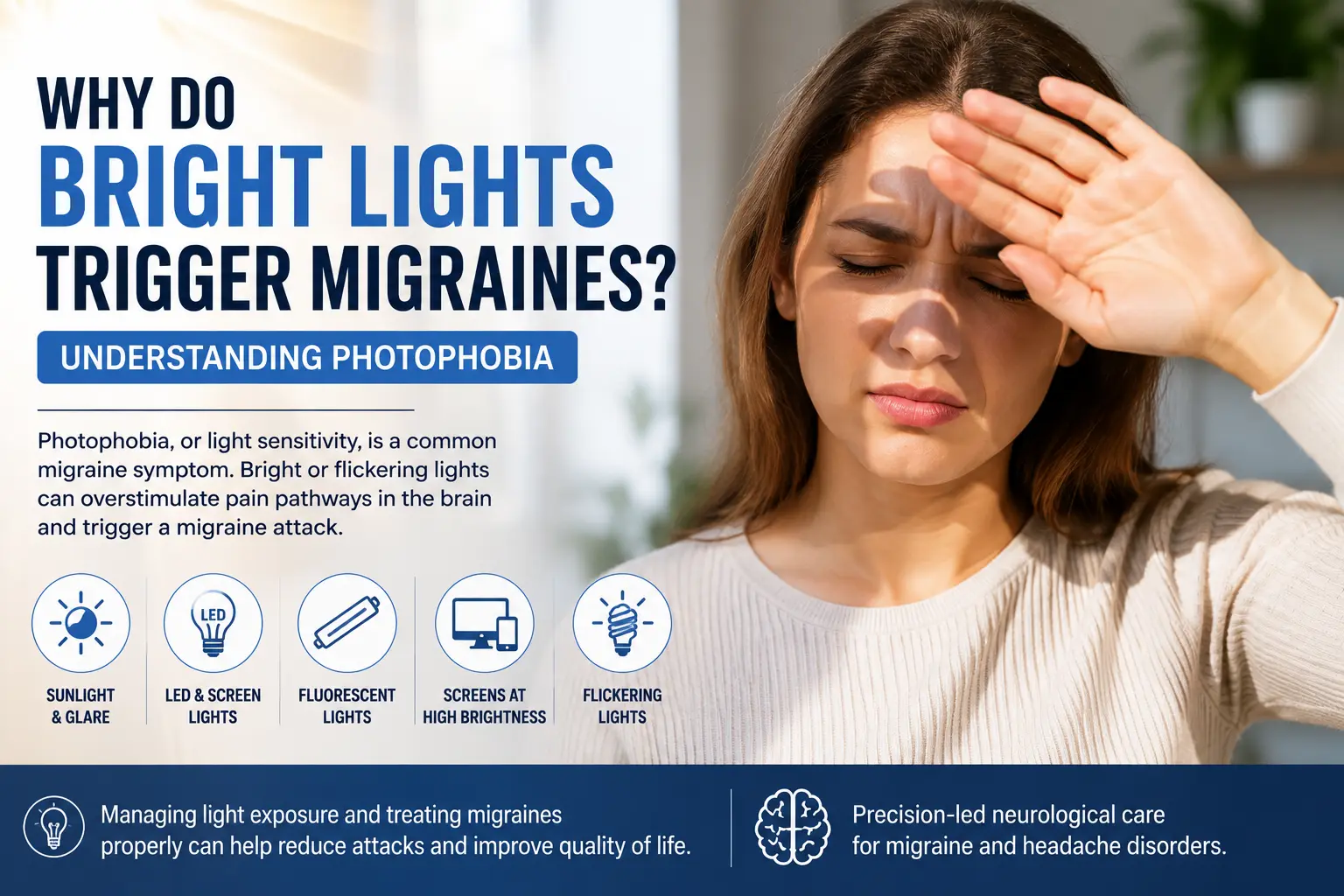
Anyone who has reached for sunglasses indoors during a headache knows the feeling: ordinary light suddenly feels unbearable.
This reaction, photophobia, is one of the most common migraine symptoms, and it raises a question patients often ask: why do bright lights trigger migraines?
Understanding this connection is the first step towards managing light sensitivity migraine episodes.
What is Photophobia?
Photophobia is often mistaken for a dislike of bright rooms, but clinically it describes an abnormal pain response to light that would not bother most people.
Typical photophobia symptoms include a sharp rise in headache pain, an urge to seek darkness, and pressure behind the eyes when looking at screens.
Recognizing these photophobia symptoms early helps distinguish migraine from other causes of light discomfort.
This light sensitivity headache pattern is a hallmark of migraine, warranting assessment when frequent or severe.
Why Do Bright Lights Trigger Migraines?
Light is among the most frequently reported migraine triggers, alongside stress, dehydration and disrupted sleep. For people experiencing frequent attacks, migraine treatment can help reduce the frequency and severity of symptoms.
Can bright lights trigger migraines? Yes, and this is well documented.
Light is among the most frequently reported migraine triggers, alongside stress, dehydration and disrupted sleep.
Exposure to intense or flickering light does not just accompany an attack, it can set one off, because light-sensitive retinal cells connect directly to the trigeminal nerve, the same pathway that transmits migraine pain signals.
How Does Light Affect The Brain During a Migraine?
During an attack, the brain becomes temporarily hypersensitive to sensory input, including light.
Specialized retinal cells, distinct from those used for ordinary vision, feed directly into pain-processing regions of the brain, and this pathway becomes overactive during a migraine, so even moderate light can feel intense.
This is central to understanding photophobia in migraine as a neurological phenomenon, not simply an eye problem.
Common Types Of Light That Can Trigger Migraines
Not all light affects people with migraine equally.
- Sunlight and glare, particularly on bright days
- LED lights: migraine complaints, as LED bulbs and screens often carry a subtle flicker and cooler, blue-toned light
- Older fluorescent tubes that flicker at low frequencies
- Phone and laptop screens at high brightness
- Flickering or strobe-like lighting, including some nightclub and cinema lighting
Warmer, dimmable, flicker-free lighting is far better tolerated by people with light-sensitivity migraine.
Who is More Likely To Experience Migraine Light Sensitivity?
- People with migraine with aura often report heightened light sensitivity.
- Those with chronic migraine (fifteen or more headache days a month) report more persistent symptoms.
- Women, diagnosed with migraine more often than men, may see hormonal influence on sensory symptoms.
- People with a family history of migraine may have a lower light threshold.
- Office workers under long hours of screen time may notice a more pronounced light sensitivity headache pattern.
Migraine is highly individual, so a detailed symptom history is the most reliable way to identify personal migraine triggers.
How To Reduce Light Sensitivity During a Migraine
- Move to a dark, quiet room as soon as symptoms begin.
- Wear tinted or photochromic lenses made for migraine-related light sensitivity, not standard sunglasses.
- Switch to warm, dimmable bulbs and avoid fluorescent tubes.
- Reduce screen brightness and use blue-light filters in the evening.
- Keep a symptom diary to identify which light sources precede an attack.
Migraine Treatment For Light Sensitivity
For frequent or disabling migraine light sensitivity, appropriate migraine and headache treatment can provide a more effective long-term approach than simply avoiding light.
Acute treatment includes fast-acting migraine-specific medication and rest in a dark environment.
Preventative treatment includes daily oral medication, targeted injectable therapies such as botulinum toxin or CGRP-targeted treatments for chronic migraine, and FL-41 tinted lenses to filter wavelengths linked to photophobia and migraine discomfort.
The right combination depends on attack frequency, severity, and how much light sensitivity affects daily life.
When Should You See a Neurologist For Migraine & Photophobia?
New visual disturbances or other neurological symptoms alongside photophobia should be assessed promptly, particularly when they resemble migraine warning signs.
- Attacks become more frequent, severe or resistant to treatment.
- Photophobia occurs without a headache, as in the prodrome phase or silent migraine.
- Light sensitivity persists well beyond the usual four to seventy-two hour attack course.
- New symptoms appear, such as visual disturbance, weakness or confusion.
- Photophobia appears with fever or neck stiffness, needing urgent assessment.
Persistent or unexplained photophobia should always be evaluated, as it can occasionally be linked to other neurological conditions.
Dr. Miguel Ley Nacher - Precision-Led Neurological Care in Dubai
Whether the question is “can bright lights trigger migraines” or “how to manage an attack”, these problems deserve more than guesswork.
Dr. Miguel Ley Nacher, who is a consulting neurologist in Dubai and has gained over ten years of international experience in Europe and North America, possesses special expertise in the accurate diagnosis and careful management of migraine and headache disorders.
FAQs - Frequently Asked Questions
Q1. Can LED lights trigger migraines?
Yes, LED lights migraine triggers are increasingly recognised, particularly cooler, blue-toned bulbs or subtle flicker.
Q2. Why do fluorescent lights make me feel sick?
Older tubes can flicker at a low, barely perceptible frequency that still overstimulates the visual system, causing headaches and eye strain.
Q3.Can sunlight trigger migraine attacks?
Yes, sunlight and glare are among the most commonly reported migraine triggers.
Q4. Does blue light make migraines worse?
Blue-toned light from screens and LEDs is thought to aggravate light sensitivity migraine more than warmer light tones.
Q5. How long does migraine light sensitivity last?
It usually mirrors the attack itself, often easing within four to seventy-two hours.
Q6. Can you have light sensitivity without a headache?
Yes, during the prodrome phase before pain begins, or with silent migraine.
Q7. What glasses help with migraine light sensitivity?
FL-41 or precision-tinted lenses are generally more effective than standard sunglasses.
Q8. Can preventing light exposure reduce migraine frequency?
It can help for some people, best combined with a broader migraine management plan.
Q9. Is photophobia a symptom of other neurological disorders?
Yes, it can also occur with conditions such as meningitis or certain eye disorders, so persistent symptoms warrant evaluation.
Related Services
Recent Blogs
Book An Appointment
About the author

Dr. Miguel Ley Nacher, MD, MSc, PhD
Consultant Neurologist & Epilepsy Specialist
MD, MSc, PhD
Consultant Neurologist
Specialist in Epilepsy & Neurophysiology
17+ Years of Experience
Al Zahra Hospital Dubai
Dr. Miguel Ley Nacher is an internationally trained Consultant Neurologist and clinical psychologist with extensive expertise in epilepsy, stroke management, movement disorders, and advanced neurophysiology. With over 17 years of experience, he is recognized for delivering evidence-based neurological care focused on accurate diagnosis, advanced treatment techniques, and long-term patient wellbeing.
He completed his medical education and specialized neurology training in Spain, followed by advanced epilepsy fellowship training in the United States at Rush University Medical Center, Chicago. Dr. Miguel also holds a Master of Science (MSc) degree and a PhD in Biomedicine, reflecting his strong academic and research background in neurological sciences.
Dr. Miguel specializes in epilepsy management, long-term video EEG monitoring (VEEG), stroke care, headaches and migraines, Parkinson’s disease, multiple sclerosis, dementia, peripheral neuropathies, and neuromodulation therapies. His approach combines advanced neurological expertise with compassionate, patient-centered care tailored to each individual’s condition and treatment goals.
He is an active member of leading international neurological organizations, including the American Academy of Neurology (AAN), American Epilepsy Society (AES), European Academy of Neurology (EAN), and the International League Against Epilepsy (ILAE).
Medical Disclaimer
This article is intended for informational and educational purposes only and should not be considered medical advice, diagnosis, or treatment. Always consult a qualified healthcare professional regarding any neurological symptoms or medical concerns before making healthcare decisions. Medically reviewed by Dr. Miguel Ley Nacher, Consultant Neurologist & Epilepsy Specialist.